Wessex Archaeology Work
Wessex Archaeology has been on site this week to begin the first phase of the archaeological work on the north side of the church – in the area between the boiler room and car park - to investigate the potential for embedding ground plant associated with Air Source Heat Pumps in the churchyard.
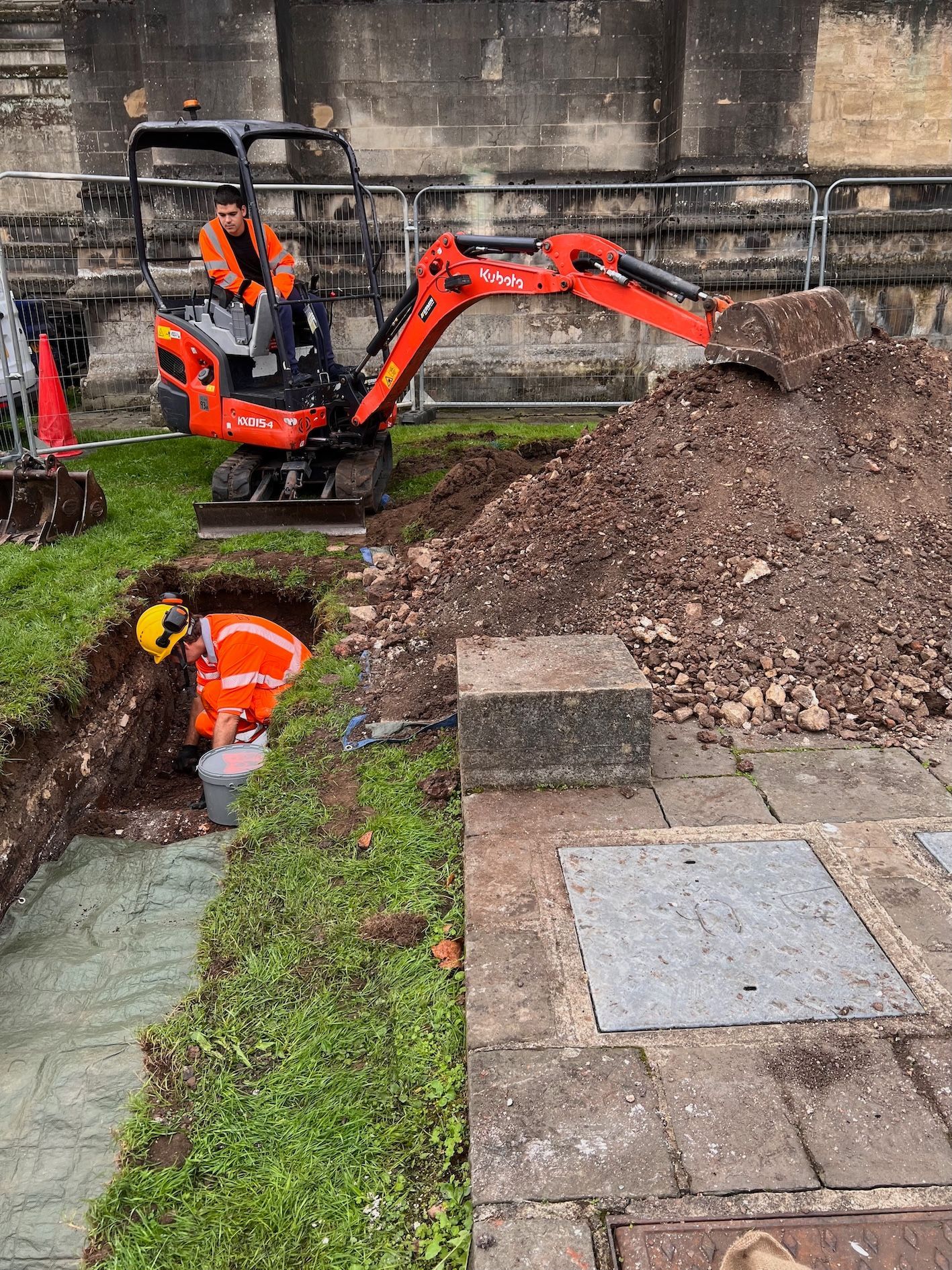
This is an initial stage in a longer-term initiative to look at improving energy usage in the church, with particular emphasis of establishing environmentally friendly methods of heating the building, consistent with the Church of England’s determination to become a net zero organisation by 2030.
The need for future planning in this area has become more acute in recent years with the decline in reliability of the existing boilers. The Air Source Heat Pumps are intended to be located in the North Transept roof space. The purpose of investigating below ground in the north churchyard is to see if there is scope for embedding ground plant associated with the system in a way that minimises its impact on the northern elevation of the church - this area of the church being home to the existing subterranean boiler room.
Wessex will also be investigating two areas to the south and west of the church: the first to establish the viability of a drainage route for proposed new toilets at the west end of the church; the second to investigate potential below pavement voids that might offer opportunities for the creation of level access to the church via the church’s west door.
As the investigation to the south will cover part of the former site of the Chapel of the Holy Spirit, which stood near the southwest angle of the church from the 1200s to the 1760s, the archaeologists will also be looking for evidence of that foundation — so significant to the medieval and early-modern history of the church, its association with Salisbury Cathedral, its relationship with the brethren of the Hospital of St John the Baptist that once stood in the area in Redcliffe Pit, and later on, its governorship of Queen Elizabeth's Free Grammar and Writing School, which occupied the chapel from 1571.