Medieval Graffiti
A fascinating new area of historical research at St Mary Redcliffe has been provoked by the discovery of previously unknown examples of medieval graffiti located at various points around the church.
There are lots of examples of graffiti at the church, visitors having carved initials into walls, doors and tombs for centuries. As far as we know, these have never been catalogued or been the subject of a detailed study.
New examples of symbolic graffiti were pointed out in 2021 by a visiting member of the Norfolk Medieval Graffiti Survey, a project that was established in 2010 with the intention of undertaking the very first large-scale survey of early graffiti inscriptions in the UK.
Small carvings of fish, ragged staffs (a symbol best known through its use in the heraldic emblem of the Earldom of Warwick) trinitarian symbols and Marian marks can be found scratched into the stone panelling on the inside of the main north entrance to the church. The marks would have been obscured by the (presumably) post Reformation painted blackletter text that once covered this area of the walls, remnants of which are still visible.
On the west interior wall of the south porch are compass-drawn circular symbols, scratch-dials (possibly rudimentary sundials) and architectural details.
In the north porch, on the interior of the north-west door to the outer porch, can be found the simple image of a church inscribed with the date 1689 and the initials LM. A similar C17th inscribed image can be seen near the Mede tomb, this time with the initials WH – the W forming a Marian mark or VV symbol.
Like most medieval graffiti, Marian marks are little understood. One discredited theory is that the symbol refers to Latin prayer or phrase ‘Virgo Virginum’, the first line of the sung prayer ‘O Virgo Virginum’, one of the ‘O Antiphons’ which were chanted at vespers in the days leading up to the feast of the Nativity. However, the symbol is much earlier having first been used as a runic symbol in Scandinavian cultures.
Many of these mysterious symbols are thought to have had apotropaic (having the power to ward off evil) significance for medieval people. Symbols are often – though by no means always - found near doors and entrances which perhaps lends some credence to this theory.
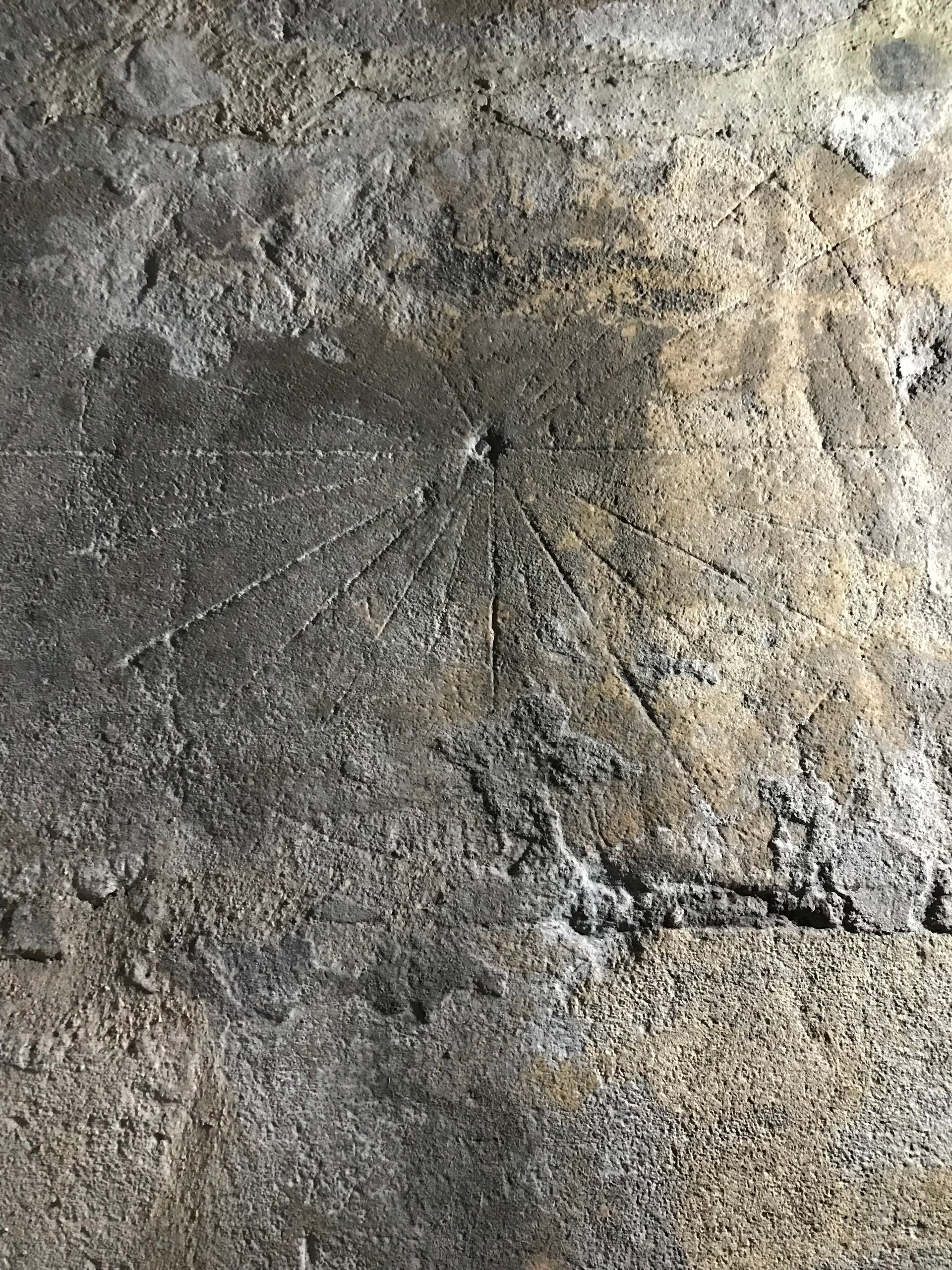
The latest find at St Mary Redcliffe is a scratch dial (see image) located on the wall of the stair from the north nave aisle to the North Transept crypt. The dial, which measures approximately 6-7” across consists of a compass drawn circle containing a central depressed point from which radial lines divide the circle into twenty-four equal portions. Scratch dials are thought to have functioned as sun dials, with the depressed point acting as the location for a projecting element that would have cast a shadow in relation to the sun. However, they do appear in places that receive little light – the stair to the crypt being a good example - a circumstance that casts doubt on their assumed use. Consequently, researchers and theorists have speculated that they may have had a symbolic, as well as a practical purpose.
Rhys Williams
2 February 2024